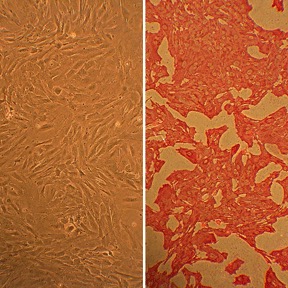
Rat Aortic Smooth Muscle Cells: RAOSMC
Rat Aortic Smooth Muscle Cells (RAOSMC) are primary smooth muscle cells isolated from rat aortic tissue.
Description
- Actomyosin Machinery: The cells regulate vascular resistance through the interaction of specialized proteins within the actomyosin apparatus. Rather than relying on actin alone, coordinated contraction is driven by complex molecular machinery.
- Homeostasis and Remodeling: They maintain the structural integrity of the vessel by secreting extracellular matrix components. Under pathological conditions, RAOSMC do not merely proliferate; they contribute to disease through altered extracellular matrix production, and phenotypic switching, including acquisition of osteogenic, macrophage-like, foam cell–like, or myofibroblast-like features.
- Regulation: Their activity is tightly coupled with endothelial cells and regulated by various growth factor signaling pathways and the influx of ions through calcium channels.
RAOSMC are widely employed to explore the molecular underpinnings of vascular disease research, providing a robust platform for testing therapeutic interventions across a range of conditions, including intimal hyperplasia, restenosis, aneurysm, hypertension, and vascular calcification.
- Disease Modeling: Research using RAOSMC examines how gene expression changes in response to mechanical stress or hyperglycemia.
- Mechanism Elucidation: By utilizing rat primary cells, scientists can isolate specific signaling cascades that trigger an inflammatory reaction or study the impact of novel compounds on preventing occlusive vasculopathies.
- Technological Development: These cells are central to developing advanced features in medical devices, such as drug-eluting stents.
To ensure high-quality cell culture results, researchers rely on rigorous characterization. Alpha smooth muscle actin is a standard marker for these cells. To confirm a mature state, researchers typically utilize a panel of markers, including SM-MHC/MYH11 and smoothelin, alongside α-SMA. Maintaining healthy, contamination-free cultures — specifically ensuring they remain free of mycoplasma — is a standard prerequisite for reliable data. Current research continues to evolve, and the integration of stem cells and studies on their differentiation potential remains a growing frontier.
- Provide a gold standard control for smooth muscle markers α-SMA, calponin and caldesmon expression
- Elucidate cytokines and growth factors signaling pathways implicated in the molecular regulation of smooth muscle cell proliferation, migration, and overall vascular function
- Demonstrate that peach extract inhibits intracellular Ca2+ and reactive oxygen species, showing promise to prevent cardiovascular diseases
- Investigate extracellular matrix properties and its role in cardiovascular health, repair of damaged vasculature and successful tissue engineering
- Demonstrate that hyperglycemia-induced elastin degradation products lead to vascular smooth muscle cell calcification
- Identify periostin, also implicated in mechanical stress and inflammation responses, as an early marker for SMC calcification
- Develop advanced stent technology, including novel surface materials, and drug delivery systems to prevent restenosis and other occlusive vasculopathies
Details
| Tissue | Normal healthy adult rat aorta | |
|---|---|---|
| QC | No bacteria, yeast, fungi, mycoplasma | |
| Character | Smooth muscle specific α-actin positive | |
| Bioassay | Attach, spread, proliferate in Growth Med | |
| Cryovial | 500,000 RAOSMC (2nd passage) frozen in Basal Medium w/ 10% FBS, 10% DMSO | |
| Kit | Cryovial frozen RAOSMC (R354-05a), Grwth Med (R311-500), Subcltr Rgnt Kit (090K) | |
| Proliferating | Shipped in Gr Med, 3rd psg (flasks or plates) | |
| Doublings | At least 16 | |
| Applications | Laboratory research use only (RUO). Not for human, clinical, diagnostic or veterinary use. |
Resources
FAQs
Need More Help?
Visit our comprehensive FAQ page for detailed answers to common questions.
Need More Help?
Visit our comprehensive FAQ page for detailed answers to common questions.
Primary Cell FAQs Powered by Bioz