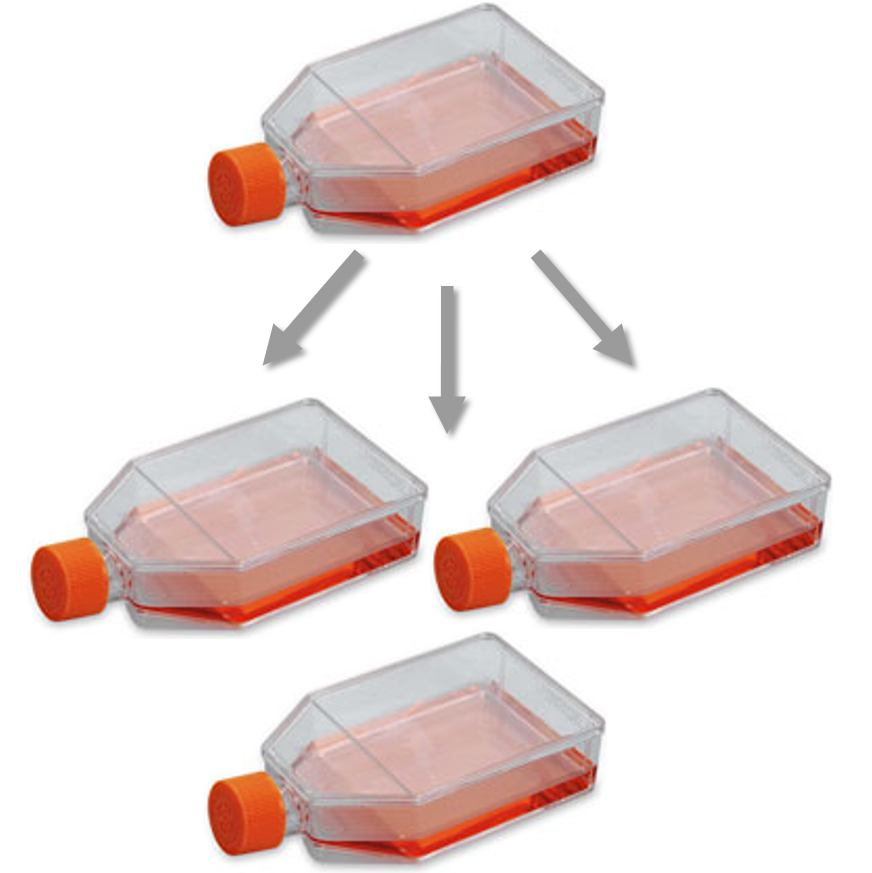
Subculture Reagents: Trypsin/EDTA, HBSS, Trypsin Neutralizing Solution formulated to keep cells healthy during cell passage. Optimized for effectiveness, population doublings and cell viability.
Subculture Reagents
Cell Applications Subculture Reagents — including Trypsin/EDTA Solution, Hanks Balanced Salt Solution (HBSS), Trypsin Neutralizing Solution (TNS), and the complete Trypsin/EDTA Subculture Reagent Kit — provide a coordinated system for the routine passaging and propagation of adherent primary cells and continuous cell lines.
Description
Cell Applications Subculture Reagents — including Trypsin/EDTA Solution, Hanks Balanced Salt Solution (HBSS), Trypsin Neutralizing Solution (TNS), and the complete Trypsin/EDTA Subculture Reagent Kit — provide a coordinated system for the routine passaging and propagation of adherent primary cells and continuous cell lines. Used together, these reagents facilitate controlled, reproducible cell detachment while protecting membrane integrity and attachment competence.
Enzymatic passaging requires a structured three-step protocol to transition adherent monolayers into single-cell suspensions:
- HBSS Wash: Removes residual culture media and serum proteins containing endogenous protease inhibitors that would otherwise neutralize trypsin prematurely.
- Trypsin/EDTA Dissociation: Combines a purified serine protease with EDTA, a chelating agent that sequesters divalent cations (Ca2+ and Mg2+) essential for cadherin- and integrin-mediated adhesion.
- TNS Neutralization: Rapidly halts enzymatic proteolysis after detachment, protecting cell surface receptors and membrane proteins prior to harvesting, counting, and reseeding.
This subculture reagent system is optimized across a broad spectrum of primary cell types grown as adherent monolayers:
- Endothelial Cells & Pericytes: Macrovascular and microvascular units that regulate vascular tone, barrier permeability, angiogenesis, and vessel stabilization.
- Epithelial Cells: Mucosal, renal, and glandular sheets that maintain tight junctional barriers, transport, and secretion.
- Fibroblasts & Stromal Cells: Connective tissue precursors responsible for extracellular matrix (ECM) synthesis, remodeling, and microenvironmental paracrine signaling.
- Vascular Smooth Muscle Cells: Medial layer mural cells that govern vascular contractility, structural integrity, and vascular remodeling.
Primary cells are significantly more sensitive to proteolytic cleavage than immortalized cell lines. Preventing over-trypsinization is essential to maintaining post-passage viability and growth kinetics:
- Temperature Management: Use reagents at room temperature (20-25°C) unless specified otherwise by cell-specific protocols; do not pre-warm reagents to 37°C.
- Microscopic Monitoring: Observe cells continuously during incubation. When cells round up and begin to loosen, gently tap the side of the vessel against the palm of your hand to encourage detachment rather than extending chemical incubation times.
- Reagent Ratios: Follow recommended volume ratios for HBSS washing and TNS neutralization to ensure complete inactivation of the protease.
When combined with appropriate ECM coating materials and growth media, this subculture system helps ensure high reproducibility in cell recovery, yield, viability, and morphology across experimental passages.
For optimal cell propagation, researchers depend on CAI Trypsin/EDTA, Trypsin Neutralization Solution, HBSS or all three together in convenient Subculture Reagent Kits. Hank’s Balanced Salt Solution is used to wash cells, Trypsin/EDTA removes adherent cells from the culture surface, and Trypsin Neutralization Solution halts the process. Our Cell Lysis buffer breaks down cell membranes to yield lysate containing protein, DNA, RNA, and for further purification.
Details
Need help choosing? See our Media Selection Guide.
 Powered by Bioz