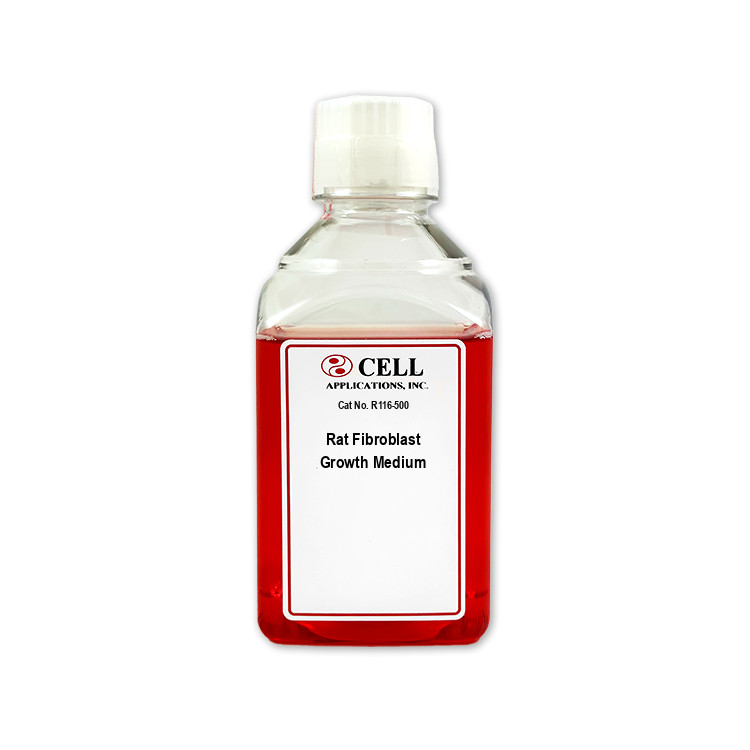
Rat Fibroblast Media for rodent Cardiac, Dermal & Lung cells
Rat Fibroblast Media
Rat Fibroblast Growth Medium: All-in-one ready-to-use media
Type: Growth Medium
Size: 500 ml
Price: $138.00
Description
Rat Fibroblast Media is a specialized cell culture system for maintaining primary rat fibroblasts and related rat fibroblast models in vitro. Fibroblasts are mesenchymal cells found throughout connective tissue, including the dermis, lung, heart, kidney, and other organs. The specific properties of a fibroblast can vary according to its tissue of origin, developmental stage, and activation state. For this reason, researchers should match the medium and experimental conditions to the source and intended use of the primary cell population.
Fibroblasts provide structural and biochemical support for tissues. Their major function is to synthesize, organize, and remodel the extracellular matrix, including collagen, fibronectin, proteoglycans, and other matrix components. Fibroblasts also release cytokines and growth factors that influence neighboring epithelial, endothelial, immune, and stromal cells. Following tissue injury, fibroblasts contribute to wound healing by migrating into damaged areas, undergoing cell proliferation, producing extracellular matrix, and, in some contexts, differentiating into contractile myofibroblasts. Excessive or persistent fibroblast activation can contribute to fibrosis and pathological tissue remodeling.
This complete medium provides the nutrients and signaling environment required for the survival, attachment, expansion, and maintenance of rat fibroblasts in culture. The basal medium supplies amino acids, carbohydrates, salts, and other essential nutrients, while serum and supplemental reagents provide proteins, lipids, hormones, vitamins, trace minerals, and additional mitogenic signals. The precise response depends on the tissue source and the formulation used. Serum concentration, extracellular-matrix coating, substrate stiffness, passage number, and cell density can all affect fibroblast morphology, proliferation, matrix deposition, and activation state.
Rat fibroblast media supports research involving fibroblast biology, extracellular-matrix production, fibrosis, inflammation, tissue repair, toxicology, pharmacology, and wound healing. Cultured rat fibroblasts can be used in migration and scratch assays, collagen and fibronectin production studies, matrix-remodeling experiments, gene-expression analyses, and investigations of responses to hormones, cytokines, pharmacological compounds, or mechanical stimuli. The media can also support gene transfection workflows by maintaining healthy, actively growing cells before and after nucleic-acid delivery. These applications are useful in experiments and disease-modeling studies involving animals, while helping researchers evaluate conserved pathways that may also be relevant to humans.
A consistent, cell-type-appropriate medium helps reduce variability caused by nutrient limitation or suboptimal growth conditions. By supporting reproducible cell proliferation and recovery of rat fibroblasts, Rat Fibroblast Media helps researchers generate uniform cultures for downstream assays and compare responses across treatments. It is intended for research use with rat fibroblasts and should not be assumed to be optimal for human fibroblasts, other animal species, epithelial cells, or immortalized cell lines without validation.
As with other cell-culture products, routine testing for contamination remains important. Antibiotics such as penicillin and streptomycin can reduce the risk of contamination by susceptible bacteria, but they do not replace aseptic technique or direct mycoplasma detection and fungal detection. Antibiotics should not be considered a substitute for monitoring mycoplasma, fungi, or other contaminants, particularly when cultures will be used for sensitive molecular, functional, or transfection experiments.
Medium carefully optimized for the characteristics and requirements unique to Rat Fibroblasts. Attention to detail ensures ideal cell health, viability, performance, physiology, morphology, consistency and data.
Details
Laboratory research use only (RUO). Not for human, clinical, diagnostic or veterinary use.
 Powered by Bioz