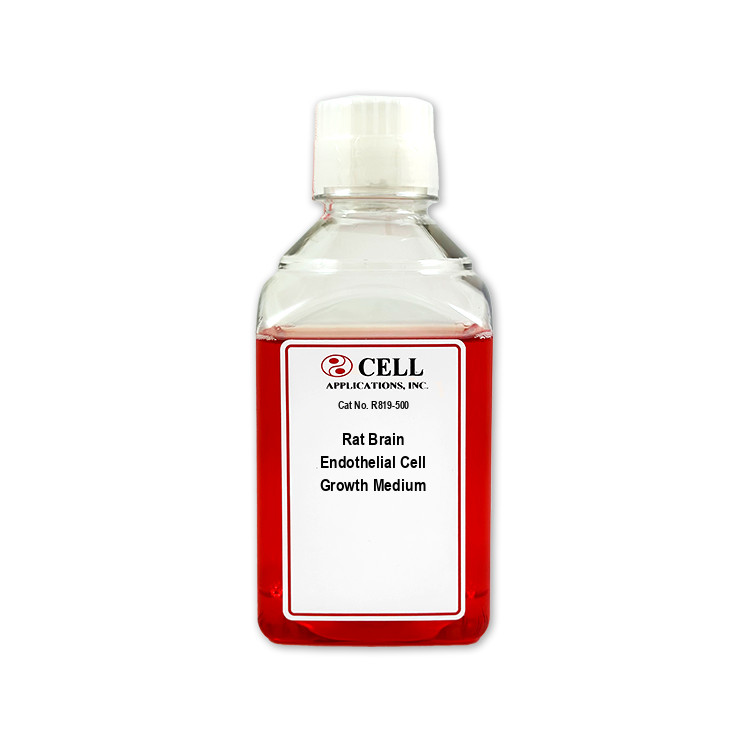
Rat Brain Endothelial Cell Media, with components and supplements optimized for rodent CNS vascular cells.
Rat Brain Endothelial Cell Media
Rat Brain EC Growth Medium: All-in-one ready-to-use
Type: Growth Medium
Size: 500 ml
Price: $156.00
Description

Brain endothelial cells function as part of the neurovascular unit, which also includes astrocytes, pericytes, neurons, microglia, and extracellular-matrix components. Signals from these neighboring cells influence endothelial barrier properties, vascular homeostasis, transport, inflammatory responses, and repair. In particular, microglia and other immune cells may interact with brain endothelial cells during neuroinflammation, toxicant exposure, infection, and cerebrovascular injury.
Rat Brain Endothelial Cell Media provide a nutrient and growth-factor environment formulated for primary rat endothelial-cell culture. Depending on the specific product format, researchers may use complete growth medium, basal medium with a separate growth supplement, or formulations that omit selected components such as phenol red, hydrocortisone, or fetal bovine serum. These options may help researchers select culture conditions appropriate for imaging, serum-restricted studies, extracellular-vesicle experiments, or other cell biology and molecular biology workflows. The medium is intended for rat primary endothelial cells and should not be assumed to support mouse endothelial cells, human primary cells, rabbit cells, monkey cells, canine cells, porcine cells, epithelial cells, astrocytes, pericytes, stem cells, immune cells, or immortalized cell lines.
Primary rat brain endothelial cells maintained in an appropriate cell culture environment may support cell-based assays involving BBB physiology, endothelial transport, vascular inflammation, neurovascular signaling, and CNS toxicology. Potential applications include analysis of endothelial morphology and marker expression, gene-expression and protein studies, permeability assays, barrier-function testing, immunofluorescence, and co-culture models with microglia or other neurovascular-unit cell types. Rat brain endothelial cells may also be incorporated into selected BBB, neurovascular-unit, toxicology, tumor-endothelial, or disease-modeling workflows, provided that the cells, medium, substrate, and assay conditions are validated for the intended application.
The medium may also be used in selected transfection or reporter-gene experiments, including studies involving GFP-expressing cells or endothelial-specific adenoviral overexpression, when these methods have been separately optimized for the primary cells. Such experiments may help investigate endothelial signaling, inflammatory responses, transport pathways, oxidative stress, or candidate therapeutic mechanisms. Endothelial-cell-derived extracellular vesicles can also be studied in models of endothelial–immune-cell communication, although extracellular-vesicle production and characterization depend on the cell state, stimulation conditions, medium composition, and isolation method.
These media are intended for research use only.
Medium carefully optimized for the characteristics and requirements unique to Rat Brain Endothelial Cells. Attention to detail ensures ideal cell health, viability, performance, physiology, morphology, consistency and data.
Details
CAI media are tested for sterility in order to confirm no bacteria, yeast or fungi contaminate the solutions. The products undergo further quality control for correct pH, osmolality and lack of endotoxins. A panel of different bioassays affirm the media sustain a proper environment for expected cell-type-specific culture, growth, plating, karyotype, physiology, morphology, viability, population doublings, surface markers, cryopreservation, differentiation and/or induction.
Laboratory research use only (RUO). Not for human, clinical, diagnostic or veterinary use.
 Powered by Bioz