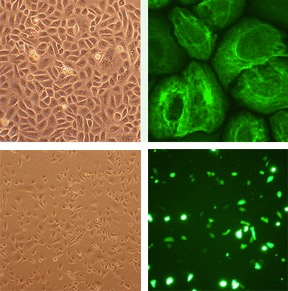
Top: Human Urethra Epithelial Cells: HUEpC (L) HUEpC immunolabeled with an anti-CK19 antibody (R). Bottom: HUEpC (L) transfected with GFP plasmid DNA using the Cytofect™ Epithelial Cell Transfection Kit (R).
Human Urethra Epithelial Cells: HUEpC
Human Urethra Epithelial Cells (HUEpC) are specialized cells isolated from the mucosal lining of the human urethra.
Description
Human Urethra Epithelial Cells (HUEpC) are specialized cells isolated from the mucosal lining of the human urethra. Sometimes referred to as urothelial cells, these cells serve as a critical physical and immunological interface, protecting the lower urinary tract from the chemical constituents of urine and external pathogens. HUEpC are found within the urethral mucosa, which lines the entire length of the urethra. The epithelial cell type varies by anatomical location: the proximal portion near the bladder consists of urothelium (transitional epithelium), while the distal regions, such as the penile urethra (also known as the spongy urethra as it is contained within the corpus spongiosum), transition toward stratified squamous epithelium. This structural diversity allows the anatomy of the urethra to withstand varying mechanical and chemical stressors during the passage of urine. The urethral epithelial lining is an active participant in the host defense system, moving beyond a passive physical liner:
- Barrier Integrity: HUEpC maintain a tight seal that limits urinary constituents—such as urea and metabolic waste—from leaking into the lamina propria and underlying muscle layers during urine transit. While the bladder is responsible for storage, the urethral epithelium ensures local homeostasis and protection of the surrounding tissues during the voiding process.
- Innate Immune Response: As the first line of defense, these cells produce proinflammatory mediators when exposed to microbes. They act as sensors that initiate immune signaling to prevent pathogens from ascending the urinary tract.
- Tissue Homeostasis: The epithelium coordinates rapid renewal and repair to maintain a smooth, intact, low-friction surface, which is essential for preventing localized inflammation and structural damage.
Researchers utilize urethral epithelial cells as a high-fidelity model to study the pathophysiology of the lower urinary tract:
- Infectious Diseases: HUEpC are frequently used to study host-pathogen interactions. This includes specialized research into how Neisseria gonorrhoeae infects the urethral lining, as well as modeling how common uropathogens like Escherichia coli adhere to the surface to cause ascending urinary tract infections.
- Urethral Stricture: These cells are essential for investigating the mechanisms of urethral stricture. While strictures often result from trauma or iatrogenic injury leading to deep fibrosis of the corpus spongiosum, researchers study how epithelial damage and subsequent signaling contribute to the scarring and narrowing of the lumen.
- Barrier Failure: Scientists use urethral epithelial cells to study how a compromised urethral mucosa increases susceptibility to ascending infections. Although infectious cystitis is primarily defined by bladder inflammation, the loss of the urethral barrier is a contributor to susceptibility to ascending infection and inflammation, which can cause significant pain and urinary urgency.
By integrating protective barrier properties with active signaling roles, Human Urethra Epithelial Cells remain an indispensable system for advancing research into urological health and the development of novel disease treatments.
Human Urethra Epithelial Cells (HUEpC) provide a good system for studies of urethral epithelial cells under normal and pathological conditions.
To meet various needs for research and development in human urethral epithelial cells, Cell Applications, Inc. has isolated and purified Human Urethra Epithelial Cells (HUEpC) to create a more realistic in vitro model. In addition to functioning as physical barriers against microbes, the urethral epithelial lining participates in the first line of host defense by producing a variety of proinflammatory mediators when exposed to microbes and microbial agents.
Characterization: Morphology consistent with epithelial origin, and positive for epithelial cell marker Cytokeratin 18
Details
| Tissue | Normal healthy human urethra | |
|---|---|---|
| QC | No bacteria, yeast, fungi, mycoplasma, virus | |
| Bioassay | Attach, spread, proliferate in Growth Med | |
| Cryovial | 500,000 HUEpC (2nd passage) frozen in Basal Medium w/ 10% FBS, 10% DMSO | |
| Kit | Cryovial frozen HUEpC (9310-05a), Growth Medium (223-500), Subcltr Rgnt Kit (090K) | |
| Proliferating | Shipped in tsfr med, psg 3, flasks or plates | |
| Doublings | At least 10 | |
| Applications | Laboratory research use only (RUO). Not for human, clinical, diagnostic or veterinary use. |
Resources
FAQs
Need More Help?
Visit our comprehensive FAQ page for detailed answers to common questions.
Need More Help?
Visit our comprehensive FAQ page for detailed answers to common questions.
Primary Cell FAQs Powered by Bioz