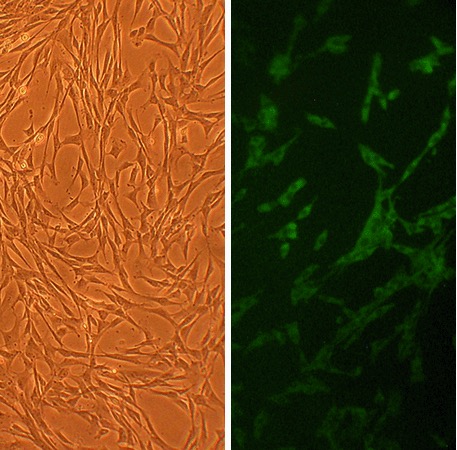
Canine Skeletal Muscle Cells: CnSkMC
Canine Skeletal Muscle Cells (CnSkMC) are primary cells isolated directly from the striated muscle tissue of dogs.
Description
Canine Skeletal Muscle Cells (CnSkMC) are primary cells isolated directly from the striated muscle tissue of dogs. In the developing organism, muscle development relies on specialized myogenic progenitors, known as myoblasts. These mononuclear cells undergo a highly regulated proliferative phase before aligning, elongating, and fusing to form multinucleated mature myotubes in vitro.
Unlike continuous cell lines that often accumulate genetic mutations and display altered differentiation kinetics, these primary cells better preserve their physiological structural and biochemical characteristics in culture. Consequently, they serve as a translationally relevant cell type model for investigating canine-specific muscle biology and function. Isolating high-quality CnSkMC requires careful processing to ensure the cell culture is cleanly separated from adjacent structural tissue components and extracellular debris.
In vivo, these cells constitute the functional parenchyma of the skeletal muscular system, which interfaces intimately with the dog’s skeleton to form the musculoskeletal apparatus. Skeletal muscle tissue is highly organized into discrete structural muscle groups that attach firmly to bone surfaces via specialized connective tissue tendons. Stability and alignment across the articulating bone segments are further maintained by a corresponding ligament network at the joints.
This complex mechanical layout is distributed throughout the animal’s limbs, anchoring the muscle groups responsible for stabilizing and moving the shoulder, hip, and leg. While smooth muscle cells are located in the walls of hollow internal organs to govern involuntary processes, striated skeletal muscle cells are uniquely organized to drive voluntary motor function.
The primary function of CnSkMC is to generate mechanical force through coordinated contraction and relaxation cycles, which directly power locomotion, posture maintenance, and overall movement. At the subcellular level, the aligned structural configuration of actin and myosin filaments allows the muscle cells to contract in response to neurological signals, translating chemical energy into physical propulsion.
Beyond their mechanical role in manipulating the limbs and supporting the skeleton, these cells play an instrumental role in systemic metabolic homeostasis, particularly regarding glucose metabolism. Skeletal muscle serves as a major site for insulin-stimulated glucose disposal in mammals. When the signaling pathways governing this metabolic uptake are disrupted, or when the physical integrity of the muscular tissue is compromised by disease, the systemic balance is impaired, contributing to insulin resistance, metabolic complications, or progressive muscle wasting.
In veterinary medicine and comparative biomedical research, CnSkMC provide a useful system to study aspects of muscular function, neuromuscular disorders, and degenerative musculoskeletal diseases. Because dogs naturally develop distinct myopathies and muscular dystrophies that closely mirror human clinical conditions, these canine primary cells can serve as an invaluable intermediate model of human diseases. Researchers use them in vitro to explore the molecular mechanics of muscle wasting, injury repair, and muscle atrophy.
CnSkMC monolayers and mature fused myotubes act as a relevant test platform for therapeutic screening and compound validation assays. Investigators utilize these cultures to evaluate how potential drug candidates influence glucose uptake, protein synthesis, and contractility under controlled experimental conditions. By analyzing the behavior of CnSkMC alongside peripheral tissue cells, scientists can isolate muscle-specific physiological responses from systemic variables, aiding the development of novel therapeutic strategies for both veterinary patients and human translational medicine.
Details
| Tissue | Normal healthy canine skeletal limb muscle | |
|---|---|---|
| QC | No bacteria, yeast, fungi, mycoplasma | |
| Bioassay | Attach, spread, proliferate in Growth Med | |
| Cryovial | 500,000 CnSkMC (1st passage) frozen in Basal Medium w/ 10% FBS, 10% DMSO | |
| Kit | Cryovial frozen CnSkMC (Cn150-05), Growth Med (Cn151-500), Subcltr Rgnt Kit (090K) | |
| Proliferating | Shipped in Gr Med, 2nd psg (flasks or plates) | |
| Doublings | At least 15 | |
| Applications | Laboratory research use only (RUO). Not for human, clinical, diagnostic or veterinary use. |
Resources
FAQs
Need More Help?
Visit our comprehensive FAQ page for detailed answers to common questions.
Need More Help?
Visit our comprehensive FAQ page for detailed answers to common questions.
Primary Cell FAQs