



(Enlarge Image) |
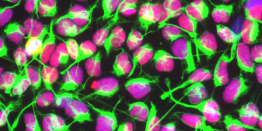
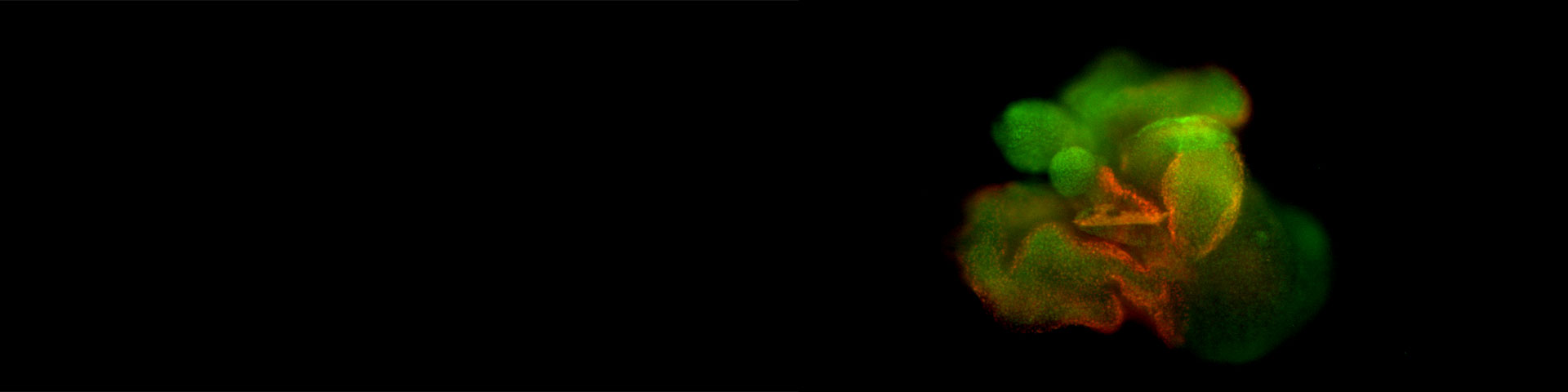
Top: Human Cervical Epithelial Cells, HCvEpC
Bottom Right: Human Cervical Epithelial Cells stained with anti-CK19 antibody
Bottom Left: Human Cervical Epithelial Cells stained with anti-CK18 C-terminal antibody |
|
 |
|
|
The cervix consists of ectocervix and the endocervix and contains two types of cells, columnar and squamous epithelial cells. Columnar epithelial cells form a single layer of mucous-secreting cells located in the endocervix and a variable portion of the ectocervix while squamous epithelial cells are located on the ectocervix. The transformation zone is the region on the ectocervix where over time the more fragile columnar epithelial cells are replaced with more durable squamous epithelial cells. This area is particularly vulnerable to pre-cancerous changes (dysplasia) due to the high turnover rate and low maturation level of the cells.
The primary cause of cervical infection or disease is acquisition of a sexually transmitted infection (STI) and a growing body of research suggests that the cervix is the primary site of HIV infection for women. Perhaps the STI with the most impact on the cervix is the human papillomavirus (HPV). In many cases, an HPV infection will heal on its own, and an infected woman may not have any future adverse effects on her cervix. If HPV persists over time, pre-cancerous cells may develop. If these pre-cancerous, or dysplastic, cells are not detected and treated they can progress to cancerous cells in the cervix.1
It has been demonstrated that transfection of primary human cervical epithelial cells with full-length HPV type 16 and 18 DNAs resulted in cell lines that could grow continuously2 and these cell lines can overcome apoptosis and become immortalized, but they are not capable of anchorage-independent growth or tumorigenic in nude mice, suggesting that they are premalignant and not malignant cells. These cells are liable to progress to anchorage-independent growth and tumorigenicity following subsequent genetic and epigenetic events. On the other hand, because immortalized epithelial cells represent an initial step in the multistep model of human carcinogenesis in vitro, they are useful for studies on the regulation by environment factors. It was shown that the E6 and E7 oncoproteins of HPV16 or HPV18 perturb normal cell cycle control through interaction with a number of cellular proteins such as E6 targets the p53 tumor suppressor protein for ubiquination and degradation, whereas E7 functionally inactivates p105-Rb. Additionally, E6 can increase telomerase activity in normal primary cells, providing an additional mechanism for escape from cellular senescence, whereas E7 binds to other members of the p105-Rb family, p107 and p130, as well as the cyclin/CDK inhibitor p21WAF1/Cip1 and suppressing their function. Compelling evidence indicates that sustained expression of the E6 and E7 oncoproteins is required for maintenance of the transformed malignant phenotype. In fact, in cervical cancer cell lines like HeLa, the p53 and p105-Rb pathways are only dormant and can be reactivated by loss of E6 and E7 expression. The consequent increase in p21WAF1/Cip1 expression in these cells can account, to a large extent, for growth suppression and senescence. In addition, down-modulation of Notch1, but not Notch2, signaling is required for sustained HPV-E6/E7 expression and HPV-induced malignant transformation.3 Furthermore, HPV E7 up-regulates SIRT1 protein which is an aging-related NAD-dependent deacetylase and this link may provide insight into the mechanism of HPV-induced cervical cell transformation.4 HPV infection of human cervical epithelial cells also leads to aberrant activation of STAT3 signaling pathway, which plays potential role in progression of HPV-mediated cervical carcinogenesis.5 Understanding these processes may help design new therapeutic strategies to control tumor growth.
Human Cervical Epithelial Cells (HCvEpCs) should provide a useful tool for studying various aspects of pathology and biology of the human cervical epithelium in vitro. To meet various needs for research and development, Cell Applications, Inc isolated and purified Human Cervical Epithelial Cells (HCvEpCs) from ectocervix of normal human cervix to create more realistic in vitro model. Cell Applications' Human Cervical Epithelial Cells (HCvEpCs) are cryopreserved at third passage and can be cultured and propagated 5 population doublings. The cells had a characteristic morphology consistent with an epithelial origin and were positive for a number of epithelial cell markers, including Cytokeratin18, Cytokeratin 19.
1. Ludmir, J. & Sehdev, H.M.: Clin. Obst. Gynecol. 43:433-9, 2000
2. Zheng, J. et al: Int. J. Cancer. 58:713-20, 1994
3. Talora, C. et al: Genes Dev. 16: 2252–63, 2002
4. Allison, S.J. et al: Aging 1:316-27, 2009
5. Shukla, S. et al: Mol. Cancer 9:282, 2010
Each lot tested negative for HIV, Hepatitis B and Hepatitis C and negative for mycoplasma, bacteria, yeast, fungi.
Products are for research use only. They are not intended for human, animal, or diagnostic applications.
|
 |
|
Tissue:
|
Normal human cervix
|
|
Cryopreserved ampoule:
|
Second passage, >500,000 cells in Epi Basal Medium containing 10% FBS & 10% DMSO.
|
|
Kit contains:
|
Ampoule of cryopreserved HCvEpC (232-05a), 500 ml Epi Growth Medium (215-500), and a Subculture Reagent Kit (090K).
|
|
Proliferating Cells:
|
Shipped in Epi Transfer Medium at third passage in either flasks or multiwell plates.
|
|
Population doublings:
|
Can be cultured 6 population doublings
|
|