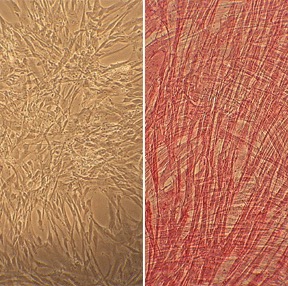
Human Umbilical Artery Smooth Muscle Cells: HUASMC. Isolated from a paired artery found in the abdominal and pelvic regions, and which in the fetus, extends into the umbilical cord.
Human Umbilical Artery Smooth Muscle Cells: HUASMC
Human Umbilical Artery Smooth Muscle Cells (HUASMC) are primary cells isolated from the tunica media of the human umbilical arteries in the umbilical cord.
Description
Human Umbilical Artery Smooth Muscle Cells (HUASMC) are primary cells isolated from the tunica media of the human umbilical arteries in the umbilical cord. Characterized by their expression of α smooth muscle actin (α-SMA) — a robust, early marker of the smooth muscle lineage — along with a canonical panel of mature proteins such as SM22α, calponin, and smooth muscle myosin heavy chain (SM-MHC), they serve as a widely utilized in vitro model.
Because α-SMA can also be expressed by activated myofibroblasts, analyzing this broader protein panel is essential for confirming a mature vascular smc identity. Derived from neonatal tissue, HUASMC offer advantages for studying baseline vascular physiology, developmental biology, and the cellular mechanisms underlying vascular remodeling and biomaterial compatibility.
These cells originate from the umbilical cord, which contains two umbilical arteries and one umbilical vein. In the fetal circulation, these arteries transport deoxygenated blood from the fetus to the placenta for gas and nutrient exchange. Unlike the systemic arteries of an adult, the umbilical artery has a thick, muscular wall specialized for rapid vasoconstriction after birth.
While HUASMC are isolated from healthy newborn tissue — minimizing many of the confounding systemic risk factors (such as cumulative exposure to smoking or chronic metabolic disease) commonly found in adult donors — it is important to note that neonatal biology is distinct. Because developmental gene programs and oxygen sensitivity in the neonate differ from adult macrovascular beds, HUASMC are best utilized as a baseline developmental model rather than a direct clinical surrogate for adult atherosclerosis or complex vascular disease.
The primary physiological role of these vascular smooth muscle cells is to regulate umbilical blood flow within the fetal-placental circulation. Their contractile machinery is well-developed, providing the force necessary for smooth muscle contraction during vessel regulation.
HUASMC provide a responsive human cell system to investigate various biochemical pathways and cellular stress responses:
- Biomaterial and Implant Compatibility: A major challenge in endovascular engineering is stent restenosis, where mechanical trauma triggers hyperplasia. HUASMC are used to test novel biomaterial surfaces and coatings designed to selectively inhibit pathological proliferation while allowing endothelial cells to populate the surface. This differential behavior is critical for designing implants that integrate rapidly without inducing hyperplastic occlusion.
- Protein Homeostasis: The ubiquitin-proteasome system is vital for maintaining cellular protein balance. Studies using HUASMC explore how proteasome inhibition or dysregulation influences smooth muscle phenotypic switching, hypertrophy, and apoptosis, offering insight into pathways relevant to arterial disease.
- Pharmacological Studies: Due to their reliable signaling, HUASMC are sometimes employed in targeted toxicological or pharmacological assays to evaluate the cellular effects of specific compounds on the blood vessel wall.
Because HUASMC offer a cleaner genetic and environmental background than cells from diseased adult arteries, they are an essential tool for developmental and comparative vascular research.
Researchers often compare these primary neonatal cells against adult models (such as those from the pulmonary artery) to identify how developmental age influences gene expression and vascular behavior. Unlike multipotent stem cells, HUASMC are committed to the smooth muscle lineage, making them a consistent model for studies focusing on mature cellular defense mechanisms and signaling integrity.
To preserve their neonatal phenotype and prevent premature drift toward a synthetic state, HUASMC require maintenance in a specialized smooth muscle cell medium supplemented with precise concentrations of growth factors. Investigators carefully control variables such as the plating density to ensure experimental reproducibility. When maintained under optimized conditions, HUASMC remain a reliable and highly cited model for exploring vascular engineering, signaling cascades, and the fundamental properties of contractile tissue.
Human Umbilical Artery Smooth Muscle Cells (HUASMC) from Cell Applications, Inc. have been used to study:
- Effects of snake venom on smooth muscle cells
- Secretion mechanism of the (pro) renin receptor
- The role of proteasomes in the development of cardiovascular diseases
- Novel material surfaces to inhibit smooth muscle cell proliferation at the same time allowing endothelial cells adhesion and proliferation in order to reduce risk associated with vascular implants
Characterization: positive for smooth muscle cell specific alpha-actin expression
Details
| Tissue | Normal healthy human umbilical artery | |
|---|---|---|
| QC | No bacteria, yeast, fungi, mycoplasma, virus | |
| Character | Smooth muscle specific α-actin positive | |
| Bioassay | Attach, spread, proliferate in Growth Med | |
| Cryovial | 500,000 HUASMC (2nd passage) frozen in Basal Medium w/ 10% FBS, 10% DMSO | |
| Kit | Cryovial frozen HUASMC (252-05n), Growth Medium (311-500), Subcltr Rgnt Kit (090K) | |
| Proliferating | Shipped in Gr Med, 3rd psg (flasks or plates) | |
| Doublings | At least 16 | |
| Applications | Laboratory research use only (RUO). Not for human, clinical, diagnostic or veterinary use. |
Resources
FAQs
Need More Help?
Visit our comprehensive FAQ page for detailed answers to common questions.
Need More Help?
Visit our comprehensive FAQ page for detailed answers to common questions.
Primary Cell FAQs Powered by Bioz