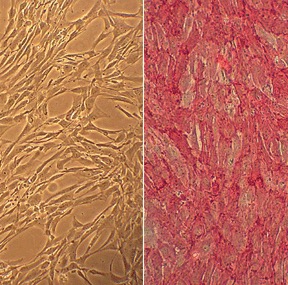
Human Brachiocephalic Artery Smooth Muscle Cells: HBcASMC. Isolated an artery of the mediastinum that supplies blood to the right arm, the head and neck.
Human Brachiocephalic Artery Smooth Muscle Cells: HBcASMC
Human Brachiocephalic Artery Smooth Muscle Cells (HBcASMC) are specialized primary cells isolated from the tunica media of the brachiocephalic trunk (also known as the brachiocephalic artery or innominate artery).
Description
Human Brachiocephalic Artery Smooth Muscle Cells (HBcASMC) are specialized primary cells isolated from the tunica media of the brachiocephalic trunk (also known as the brachiocephalic artery or innominate artery). As a principal smooth muscle cell type within a major conduit vessel located on the right side of the superior mediastinum within the superior thorax and base of the neck, HBcASMC regulate vascular tone and structural integrity, serving as an essential model for studying the cellular mechanisms of severe vascular disease.
The brachiocephalic trunk is the first and largest branch to arise from the aortic arch, ascending superiorly and to the right before dividing into the right common carotid artery and the right subclavian artery (contrasting with the left common carotid and left subclavian artery, which arise independently directly from the aortic arch). Due to complex hemodynamics (including disturbed flow and wall shear stress gradients), the brachiocephalic/right carotid region is recognized—alongside other predisposed anatomical sites like the carotid bifurcation, coronary ostia, and iliac bifurcations—as a common location for the development of complex atherosclerotic lesions. Because atherogenesis at these sites is multifactorial, driven by local wall biology, blood flow patterns, and systemic risk factors, Human Brachiocephalic Artery Smooth Muscle Cells (HBcASMC) provide a useful system to examine VSMC contributions to the formation of an atherosclerotic plaque.
In healthy tissue, these vascular smooth muscle cells exhibit a contractile phenotype. In response to vascular injury or metabolic stress, they possess significant phenotypic plasticity, undergoing a transition to a synthetic state that drives several pathological processes:
- Neointimal Cellularity: Activated Human Brachiocephalic Artery Smooth Muscle Cells (HBcASMC) undergo both hyperplasia (increased cell number via proliferation) and hypertrophy (increased cell size). While hypertrophy increases structural mass, cellular proliferation is an important contributor to neointimal cellularity and the subsequent narrowing of the vessel lumen in atherosclerosis and stent restenosis.
- Intimal Migration: Synthetic smooth muscle cells migrate from the tunica media into the tunica intima to form the neointima. While contemporary lineage-tracing studies demonstrate that intimal cells can also derive from other sources—such as endothelial-to-mesenchymal transition (EndMT), adventitial cells, or circulating progenitors—medial VSMCs remain one of the major contributors to this process.
- Vascular Calcification: Under inflammatory or osteogenic stimuli, Human Brachiocephalic Artery Smooth Muscle Cells (HBcASMC) can undergo an osteogenic transition, and contribute to mineral deposition (via osteogenic differentiation and matrix vesicle release) into the extracellular matrix. Plaque mineralization is highly heterogeneous, involving inflammatory cells, necrotic core-driven passive mineralization, and extracellular vesicle nucleation alongside this VSMC-driven process of vascular calcification.
Human Brachiocephalic Artery Smooth Muscle Cells (HBcASMC) allow researchers to investigate how systemic metabolic disorders and mechanical forces accelerate arterial degradation:
- Type 2 Diabetes: In the context of type 2 diabetes, accelerated atherogenesis involves chronic hyperglycemia and advanced glycation end-products (AGEs). Researchers use Human Brachiocephalic Artery Smooth Muscle Cells (HBcASMC) to study how these diabetic conditions trigger inflammatory pathways and exacerbate the synthetic phenotypic switch.
- Hypertension: By exposing these cells to cyclic mechanical stretch in cell culture, scientists can model the effects of chronic high blood pressure on smooth muscle-mediated vascular remodeling.
These human primary cells are typically maintained in a high-quality human smooth muscle cell growth medium formulated with precise concentrations of growth factors and essential supplements. By utilizing these primary models rather than immortalized cell lines, researchers gain a more translationally accurate understanding of the cellular behaviors required to develop targeted therapies that stabilize advanced plaques and prevent vascular occlusion.
Human Brachiocephalic Artery Smooth Muscle Cells (HBcASMC) provide a useful in vitro system to study all aspects of cardiovascular function and disease, especially those related to mechanisms of hyperplasia and hypertrophy of intimal smooth muscle cells leading to vascular occlusion in atherosclerosis and stent restenosis.
Characterization: positive for smooth muscle cell specific alpha-actin expression.
Characterization: Positive for smooth muscle cell specific alpha-actin expression. – See more at: http://www.cellapplications.com/product/human-aortic-smooth-muscle…
Details
| Tissue | Normal healthy brachiocephalic artery | |
|---|---|---|
| QC | No bacteria, yeast, fungi, mycoplasma, virus | |
| Character | Smooth muscle specific α-actin positive | |
| Bioassay | Attach, spread, proliferate in Growth Med | |
| Cryovial | 500,000 HBcASMC (2nd passage) frozen in Basal Medium w/ 10% FBS, 10% DMSO | |
| Kit | Cryovial frozen HBcASMC (3512-05a), Gr Med (311-500), Subcltr Rgnt Kit (090K) | |
| Proliferating | Shipped in Gr Med, 3rd psg (flasks or plates) | |
| Doublings | At least 12 | |
| Applications | Laboratory research use only (RUO). Not for human, clinical, diagnostic or veterinary use. |
Resources
FAQs
Need More Help?
Visit our comprehensive FAQ page for detailed answers to common questions.
Need More Help?
Visit our comprehensive FAQ page for detailed answers to common questions.
Primary Cell FAQs Powered by Bioz