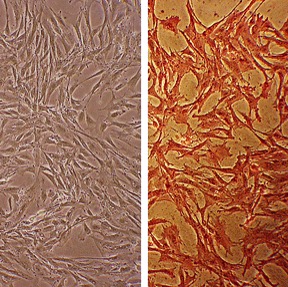
Bovine Aortic Smooth Muscle Cells: BAOSMC. Isolated from the main artery of the body, supplying oxygenated blood to the circulatory system.
Bovine Aortic Smooth Muscle Cells: BAOSMC
Bovine Aortic Smooth Muscle Cells (BAOSMC) are specialized mesenchymal cells isolated from the tunica media of healthy aorta tissue.
Description
Bovine Aortic Smooth Muscle Cells (BAOSMC) are specialized mesenchymal cells isolated from the tunica media of healthy aorta tissue. Within the large elastic arteries, vascular smooth muscle cells (VSMCs)—often referred to as vascular smooth muscle cell or muscle cell populations—are responsible for maintaining structural integrity, regulating vascular tone, and modulating blood pressure via coordinated contraction and relaxation. Structurally characterized by an elongated “hill-and-valley” morphology in vitro, BAOSMC possess high phenotypic plasticity, shifting between a quiescent, contractile state and an active, synthetic state in response to environmental cues. Because their structural size and hemodynamic profiles align with human macrovascular physiology, they serve as a translationally rigorous model for investigating vascular disease, mapping the biology of the artery, and advancing tissue engineering. For optimal results, these cells are maintained in a specialized Bovine SMC basal medium.
BAOSMC models are widely deployed to dissect the molecular mechanisms driving progressive arterial disease, particularly those affecting the aortic wall and the wider vascular wall.
- Vascular Remodeling: In conditions such as abdominal aortic aneurysm or aortic dissection, the balance of homeostatic signaling is disrupted. Factors like angiotensin II can drive pathological vascular remodeling, stimulating excessive DNA synthesis, proliferation, and migration.
- Atherogenesis and Inflammation: These cells participate in plaque formation through interactions with circulating lipoproteins and inflammatory cells. The accumulation of matrix components and the transformation of the vessel phenotype are critical drivers in the progression of systemic vascular disease.
The contractile function of these cells is defined by their highly organized cytoskeletal architecture, which is central to their role in the coronary artery and aortic arch.
- Contractile Markers: The presence of α smooth muscle actin (α-SMA) and various actin isoforms is fundamental to their identity. Differentiation status is often assessed by the expression of these structural proteins, which decrease as cells transition to a more synthetic phenotype.
- Signaling Pathways: The response of BAOSMC to a growth factor or mechanical stimuli dictates their behavior within the aortic tissue. By mapping these cascades, researchers gain insight into how cells respond to the complex environment within an artery, providing benchmarks for clinical vascular surgery and therapeutic interventions.
Beyond traditional cardiovascular medicine, BAOSMC have emerged as a cornerstone model for bioengineering and food science.
- Cultivated Meat and Biomimicry: Realizing a true-to-nature cultivated steak requires duplicating the multi-lineage architecture of conventional meat. Researchers utilize BAOSMC in combination with myoblasts and adipocytes to create sophisticated, multicellular tissue models that replicate the mechanical “bite” and texture of native beef.
- Advanced Diagnostics: Due to their robust and uniform handling profiles, BAOSMC serve as living cell controls to test and validate emerging microfluidic and optical screening technologies. These applications range from benchmarking handheld sensors to validating high-resolution imaging platforms, solidifying their role as a foundational tool in modern biotechnology.
Bovine Aortic Smooth Muscle Cells (BAOSMC) provide an excellent model system to study all aspects of cardiovascular function and disease, especially those related to mechanisms of hyperplasia and hypertrophy of intimal smooth muscle cells leading to vascular occlusion in atherosclerosis and stent restenosis.
BAOSMC from Cell Applications, Inc. have been utilized in a number of research studies, for example, to:
- Elucidate RhoA-dependent serum response signaling pathways
- Observe the role of FAK in thrombospondin-1 induced migration of vascular smooth muscle cells
- Demonstrate the relationship between the disturbed flow and proliferation of smooth muscle cells, leading to intima hyperplasia
- Study interactions between lipoproteins and extracellular matrix, as well as mechanisms of lipoprotein aggregation contributing to atherosclerosis
- Construct an expression cassette to maximize targeted transgene expression
- Test new technologies, such as on-chip contact imaging technique, handheld fluorometers and a “nose on a chip” olfactory sensor
- Study the behavior of smooth muscle cells in 3d environment and smooth muscle/endothelial co-cultures
- Describe an origami-like method of generating three-dimensional (3D) cell-laden microstructures
- Design materials for tissue engineering and cardiovascular implants
Characterization: positive for smooth muscle cell specific alpha-actin expression
Details
| Tissue | Normal healthy bovine aorta | |
|---|---|---|
| QC | No bacteria, yeast, fungi, mycoplasma | |
| Character | Smooth muscle specific α-actin positive | |
| Bioassay | Attach, spread, proliferate in Growth Med | |
| Cryovial | 500,000 BAOSMC (2nd passage) frozen in Basal Medium w/ 10% FBS, 10% DMSO | |
| Kit | Cryovial frozen BAOSMC(B354-05), Growth Medium (311-500), Subcltr Rgnt Kit (090K) | |
| Proliferating | Shipped in Gr Med, 3rd psg (flasks or plates) | |
| Doublings | At least 16 | |
| Applications | Laboratory research use only (RUO). Not for human, clinical, diagnostic or veterinary use. |
Resources
FAQs
Need More Help?
Visit our comprehensive FAQ page for detailed answers to common questions.
Need More Help?
Visit our comprehensive FAQ page for detailed answers to common questions.
Primary Cell FAQs Powered by Bioz